Xinhua
15 Apr 2026, 21:48 GMT+10
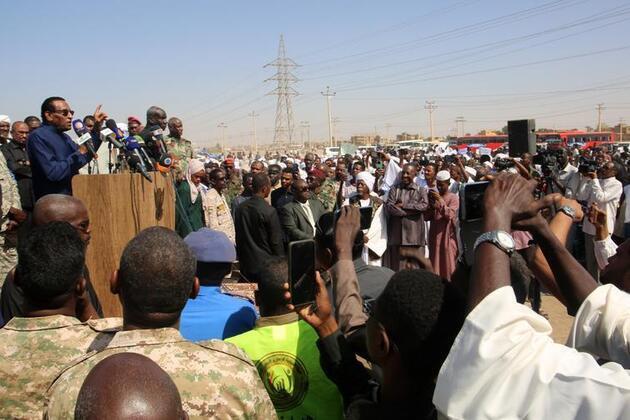
KHARTOUM, April 15 (Xinhua) -- As Sudan's conflict enters its third year, the country remains trapped in a protracted crisis with no immediate resolution in sight, only a shifting battlefield and a mounting human and economic toll.
Since erupting on April 15, 2023, the war has killed tens of thousands, displaced millions, and ruined the economy.
Competing centers of power, a divided map of military control, and continued fighting have deepened instability, while a worsening humanitarian crisis, widely described as the world's largest, unfolds alongside stalled political efforts.
Politically, Sudan is deeply divided, with an internationally recognized government aligned with the Sudanese Armed Forces (SAF), and a parallel administration declared by the paramilitary Rapid Support Forces (RSF) in alliance with political and armed groups. Analysts warn that this fragmentation of authority is prolonging the conflict and raising fears of further instability.
"The continued existence of two parallel authorities creates a fragile political environment that makes a settlement difficult," political analyst Salah Shuaib told Xinhua.
The competing domestic interests, along with the involvement of multiple regional actors, continue to complicate the situation and hinder the emergence of an effective political initiative, said Shuaib.
"Any viable solution requires broad political consensus that goes beyond the binary of military confrontation and lays the groundwork for a transitional phase addressing the root causes of the crisis," he noted, adding that such a scenario remains distant.
On the ground, the conflict has produced a fragmented and fluid map of control. The army currently holds full control over nine of Sudan's 18 states, while RSF forces control six, including the five Darfur states and West Kordofan.
The remaining three states, namely South Kordofan, North Kordofan, and Blue Nile, remain active conflict zones, where control is contested, and frontlines continue to shift. While the army maintains control of key urban centers, RSF forces operate across surrounding rural areas, contributing to a dynamic and unstable battlefield.
"The shift in combat patterns over the past three years has expanded and complicated the conflict," Sudanese military expert Abdul-Jalil Ismail told Xinhua. "The war is no longer fought along traditional frontlines, but through flexible deployments across multiple regions, particularly in Kordofan and Darfur."
Ismail added that the increasing use of drones and long-range shelling has brought the conflict deeper into residential areas, raising civilian casualties and further disrupting daily life.
Humanitarian conditions have deteriorated sharply, with millions caught between displacement and uncertain returns.
On April 10, Marie-Helene Verney, the United Nations High Commissioner for Refugees (UNHCR) Representative in Sudan, said in a briefing that around 14 million people have been forced to flee since the conflict began, including 9 million internally displaced and 4.4 million who have crossed into neighboring countries, which means roughly one in four Sudanese has been uprooted.
According to international estimates, around 34 million people in Sudan now require humanitarian assistance, which is the highest number globally.
The UN Office for the Coordination of Humanitarian Affairs (OCHA) reported that 29 million people in Sudan are struggling to access sufficient food, while 33.7 million, more than two-thirds of the population, require humanitarian assistance.
"Fighting is still ongoing in large parts of the country, with no clear progress toward a resolution," Verney said.
Diplomatic efforts to end the conflict have made limited progress, with mediation initiatives stalled amid entrenched positions, ongoing violence, and differing regional and international approaches.
"Sudan has entered a phase of military stalemate, where neither side can achieve a decisive victory and political will for a negotiated settlement remains limited," Sudanese conflict researcher Naji Ajib told Xinhua.
"The coming period is likely to see continued, intermittent fighting with only marginal shifts on the ground, rather than any fundamental breakthrough," he added.
Get a daily dose of Baton Rouge Post news through our daily email, its complimentary and keeps you fully up to date with world and business news as well.
Publish news of your business, community or sports group, personnel appointments, major event and more by submitting a news release to Baton Rouge Post.
More InformationWASHINGTON, D.C.: A proposed tie-up between United Airlines and American Airlines could dramatically reshape the U.S. aviation sector,...
WASHINGTON, D.C.: Rising energy costs linked to the Iran war pushed U.S. wholesale prices sharply higher in March, adding to inflation...
NEW YORK, New York - U.S. stocks continued their march higher on Tuesday, buoyed by prospects the U.S. and Iran may soon return to...
WASHINGTON, D.C.: The global economy is entering a period of heightened risk as the war in Iran disrupts energy markets, with the International...
LONDON, U.K.: Tesco is stepping up its digital transformation by partnering with U.S. software firm Adobe to harness artificial intelligence...
DETROIT, Michigan: Electric vehicle startup Slate Auto has secured US$650 million in fresh funding as it prepares to bring its first...
KHARTOUM, April 15 (Xinhua) -- As Sudan's conflict enters its third year, the country remains trapped in a protracted crisis with no...
According to reports, Tehran is only ready to agree to a five-year pause on its nuclear energy program ...
According to reports, Tehran is only ready to agree to a five-year pause on its nuclear energy program A 20-year uranium enrichment...
By Vishu Adhana Islamabad [Pakistan], April 15 (ANI): Former Pakistani minister Fawad Chaudhry on Wednesday stated that there are...
BEIRUT/CAIRO, April 15 (Xinhua) -- Lebanon said Wednesday it has filed an urgent complaint to the UN over Israeli airstrikes on April...
How the US attack on Iran is pushing the world towards chaos and new conflicts The war launched by the United States and Israel against...