Xinhua
18 Mar 2026, 09:15 GMT+10
The current crisis is a reminder of how fragile progress can be.
by Xinhua Writer Duan Minfu
BAGHDAD, March 18 (Xinhua) -- In a dim cafe in the Karrada district of Baghdad, a television flickered with footage of fireballs streaking across a night sky. The news played on for hours; no one changed the channel. Men leaned forward in their chairs, watching intently, occasionally murmuring in low voices.
"Once again, Iraq has become the battlefield for other people's wars," said an old man, sitting next to me. "I have lived through the Iran-Iraq War, the Desert Storm, the American invasion, and ISIS." He paused. "And now, this."
Since the United States and Israel launched coordinated strikes against Iran on Feb. 28, Iraqis have spent more than two weeks watching their country be pulled into another regional conflict it did not choose.
Wedged between Israel and Iran, Iraq's airspace has become a shared corridor for missiles and drones. U.S. and Israeli forces struck camps belonging to Iran-aligned militias across the country. In retaliation, Iranian missile barrages targeted U.S. assets in the region, including facilities in Iraq.
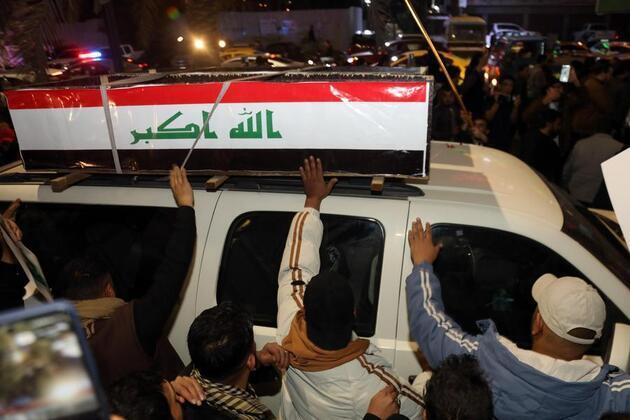
Days of street protests followed. The message was the same everywhere: End the American military presence and restore Iraqi sovereignty -- words that Iraqis have repeated in various forms for over two decades.
Nayyir, a retired teacher who had participated in the protests, said, "Any security guarantee purchased at the cost of sovereignty is an illusion built on air."
Beside him, Omar, a young man who had also taken part in the demonstrations, put it more bluntly: "For over 20 years, America has used security cooperation and counterterrorism as its excuse. The moment great-power rivalries escalate, Iraq becomes someone else's battlefield."
What makes the current crisis so bitter is its timing.
Iraq had been improving, if you measure carefully and hope generously. Over years of reporting here, I watched markets stay open deep into the night, their stalls piled high with oranges and pomegranates. Young people filled newly opened bookshops in Karrada, their conversations shifting from survival to the future: startup plans, graduate school, and what they might build. Construction cranes rose against the skyline. Security checkpoints still dotted the roads, but the worst of the dread had begun to lift.
The current crisis is a reminder of how fragile progress can be.
At the edge of Baghdad's Green Zone, the U.S. embassy compound looms behind its blast walls. Soldiers grip their rifles with both hands.
Pointing at the Green Zone walls, taxi driver Ali Hassan said: "Today's Iran looks exactly like Iraq did 23 years ago."
"I remember 2003," said Hassan, who had parked his cab and joined the protests. "I remember asking myself every morning: Will I make it home tonight? Will my children's school still be standing?"
"Now the Americans and Israelis are delivering that same fear to Iran. And we are caught in the middle. Again," he said, his voice rising with each word.
For Hassan and millions of Iraqis, 2003 is not history but an unhealed wound. Washington's recent public objections to the possible return of former Prime Minister Nouri al-Maliki during government formation have only sharpened local grievances.
"They destroyed our country," a shopkeeper told me at his stall. "And now they want to tell us who gets to lead it."
While the protests continued, so did the war. On television screens in Baghdad's cafes and teahouses, the footage looped endlessly, nearly identical everywhere: smoke and flames rising over Tehran, the same arc of light carving across the same dark sky.
Iraq and Iran, along with much of the Middle East, once nurtured the world's first cities and the earliest known writing system. For much of the past half-century, however, they have served as stages for too many wars, with countless precious heritages destroyed in them. More than 10 years ago, the Islamic State (IS) terrorist group, also known as ISIS, ravaged the Mosul Museum and the ancient cities of Hatra and Nimrud in Iraq. Now, Tehran's Golestan Palace has been damaged by U.S.-Israeli airstrikes.
The people here are not asking for anyone's protection, nor to serve as anyone's strategic asset. What they want is simpler than many would expect: the pomegranates on the market stalls will still be there tomorrow morning, the lights in the bookshops stay on, and their lives have a chance to continue on their own terms.
In the dim cafe in Karrada, the television still played. The old man who spoke of wars had left, but others had taken his seat. They leaned forward, watching the same footage loop again.
Nearby, a market was still open, and the stores still lit.
For now.
Get a daily dose of Baton Rouge Post news through our daily email, its complimentary and keeps you fully up to date with world and business news as well.
Publish news of your business, community or sports group, personnel appointments, major event and more by submitting a news release to Baton Rouge Post.
More InformationNEW YORK, New York - Despite another two high profile assassinations by Israel in Iran, spiking oil prices, and a central bank hiking...
NEW DELHI, India: Indian fintech firm PhonePe has temporarily halted plans for an initial public offering, citing geopolitical tensions...
SAN FRANCISCO, California: Apple's newly announced MacBook Neo, a low-cost laptop aimed at students, is the most repairable notebook...
CHICAGO, Illinois: U.S. airlines are increasingly relying on revenue from co-branded credit cards, reshaping how loyalty programs reward...
NEW YORK/SAN FRANCISCO: Meta is considering sweeping layoffs that could affect 20 percent or more of its workforce as the company seeks...
NEW YORK, New York - U.S. stock markets closed firmly in positive territory on Monday, building momentum throughout the session to...
NEW YORK CITY, New York: Michael Bloomberg has again been named the biggest donor in the United States, topping the Chronicle of Philanthropy's...
US President Donald Trump (R) and Russian President Vladimir Putin attend a meeting at Joint Base Elmendorf-Richardson in Anchorage,...
The current crisis is a reminder of how fragile progress can be. by Xinhua Writer Duan Minfu BAGHDAD, March 18 (Xinhua) -- In a...
Kabul [Afghanistan], March 18 (ANI): Over 400 people have been reported killed in the deadly airstrike carried out by Pakistan on an...
New Delhi [India], March 18 (ANI): Irish Ambassador to India, Kevin Kelly, hailed the importance of ties between New Delhi and Dublin...
Tehran [Iran], March 18 (ANI): Iranian Parliament Speaker Mohammad Baqer Qalibaf has warned that the situation in the Strait of Hormuz...